Beyond the RFQ: AI for Smarter Subcontractor Inquiries in Construction
In construction procurement, the Request for Quote (RFQ) is foundational. Yet, for too long, it has been a bottleneck—a manual, often inconsistent process leading to unclear bids, scope creep, and ultimately, cost overruns. The traditional RFQ, drafted from disparate documents and institutional memory, frequently lacks the precision required to solicit truly comparable and competitive proposals. This imprecision cascades through the entire project lifecycle, from bid leveling to contract execution and payment.
The solution lies in leveraging artificial intelligence to transform how we generate and manage subcontractor inquiries. This isn't about automating a flawed process; it's about fundamentally restructuring it to ensure clarity, consistency, and risk reduction from the outset.
The Pitfalls of Manual RFQ Generation
Consider a typical scenario: a GC is soliciting bids for a multi-trade fit-out. The project manager or estimator manually sifts through architectural drawings, specifications, and previous project scopes to cobble together an RFQ for, say, the drywall package. Critical details—specific fire ratings for partitions, acoustical requirements for ceilings, or precise finish levels for walls—are easily overlooked or ambiguously phrased. This leads to a patchwork of bids where one sub prices out 5/8" Type X drywall throughout, another assumes standard 1/2", and a third omits acoustical sealant, resulting in a 10-15% variance on a $250,000 package before any scope adjustments. This isn't competitive bidding; it's comparing apples to oranges, forcing extensive RFI rounds and bid adjustments that cost time and money.
Manual RFQs are prone to:
- Inconsistent scope definition across multiple trades.
- Ambiguous language leading to differing interpretations.
- Omission of critical project requirements or site-specific conditions.
- Lack of standardized formatting, complicating bid comparison.
AI's Role in Structured RFQ Creation
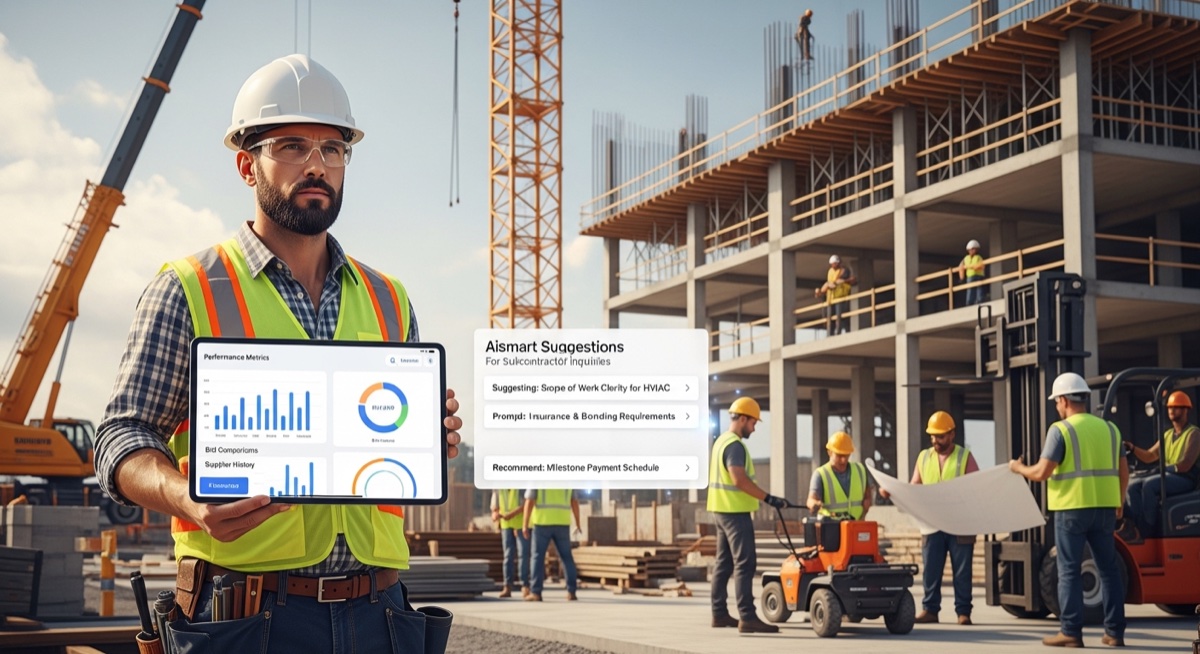
This is where AI intervenes. Instead of manual compilation, an AI-powered platform can analyze your project's scope of work—including specifications, drawings, and even previous project data—to automatically generate a highly structured and comprehensive RFQ. Trueleveler's RFQ Generator engine extracts key data points, identifies specific material requirements, labor scopes, and project conditions, and then compiles them into a consistent, actionable inquiry document.
For example, instead of a generic request for "HVAC installation," the AI can parse mechanical schedules and specifications to generate an RFQ that specifically itemizes: "Install (2) 5-ton RTUs with economizers, ductwork per SMACNA standards, VAV boxes with DDC controls, and test & balance services for 25,000 sq ft office space, including all refrigerant piping and condensate lines." This level of detail ensures every potential subcontractor is bidding on the exact same scope, eliminating guesswork and reducing the likelihood of costly change orders later.
Beyond Generation: Ensuring Bid Comparability
A well-structured RFQ is the first step towards true bid comparability. When all subcontractors receive an inquiry with standardized sections, clear scope definitions, and explicit requirements, their responses naturally align more closely. This transforms the subsequent bid leveling process from a qualitative interpretation exercise into a quantitative comparison.
Trueleveler's Bid Leveling engine takes these structured bids and allows you to compare up to five vendor quotes side-by-side, highlighting discrepancies in scope, materials, and pricing with precision. This not only saves hours of manual spreadsheet work but also provides an objective basis for negotiation, ensuring you select the best value, not just the lowest number based on an incomplete scope.
Stop Guessing. Start Comparing.
Leverage the RFQ Generator to create clear, structured inquiries that make bid leveling effortless and accurate.
Mitigating Risk from the Outset
The benefits of AI-generated RFQs extend far beyond the initial bidding phase. A precise RFQ minimizes ambiguity, which is a primary driver of contract disputes and project delays. When the scope is clearly defined upfront, the risk of differing interpretations between parties is significantly reduced, paving the way for smoother contract negotiations.
Hidden Liabilities in Vague Language
An RFQ that simply states "site cleanup" without specifying frequency, scope (e.g., daily debris removal, final construction clean), or responsibility can lead to a subcontractor claiming additional costs for routine cleanup, citing the ambiguity in the original scope. This can quickly add $5,000-$10,000 to a small project or significantly more on larger ones.
When it comes time to draft or review the actual subcontract agreement, the clear parameters established by an AI-generated RFQ become invaluable. Trueleveler's Contract Review engine can then analyze the proposed contract for clauses that deviate from the agreed-upon scope or introduce unfavorable terms, flagging potential risks automatically. Furthermore, the detailed scope from your RFQ and subsequent Purchase Order (PO) can be leveraged by the Document Compare engine to detect discrepancies against subcontractor invoices, ensuring you only pay for what was agreed upon and delivered.
Clarity Prevents Disputes
By using the RFQ Generator to specify exact requirements for site protection, material handling, or payment terms, you proactively eliminate gray areas. This directness not only secures more accurate bids but also streamlines subsequent contract negotiations and reduces the potential for costly disputes and change orders down the line.
The Bottom Line
The era of generic, manually intensive RFQs is over. AI is transforming construction procurement by enabling the generation of precise, structured subcontractor inquiries that set the stage for accurate bids, streamlined comparisons, and robust risk mitigation. This shift is not merely about efficiency; it's about fundamentally improving project predictability and profitability.
By integrating tools like Trueleveler's RFQ Generator into your workflow, you move beyond basic inquiry to intelligent, data-driven procurement. This holistic approach ensures that every inquiry is complete, every bid is comparable, every contract is robust, and every payment aligns with the agreed scope, ultimately delivering projects on time and within budget. Experience the future of construction procurement.