Reviews subcontracts, POs, and master agreements against your firm's preferred terms. Flags indemnity overreach, missing waivers, payment-term drift — with severity-tagged findings and recommended counter-language. Built for PMs and estimators, not lawyers.
Six categories cover ~80% of what real subcontracts go sideways on. Every flag carries a severity tag, the exact clause language, and the counter-language we'd recommend — ready to paste into your redline.
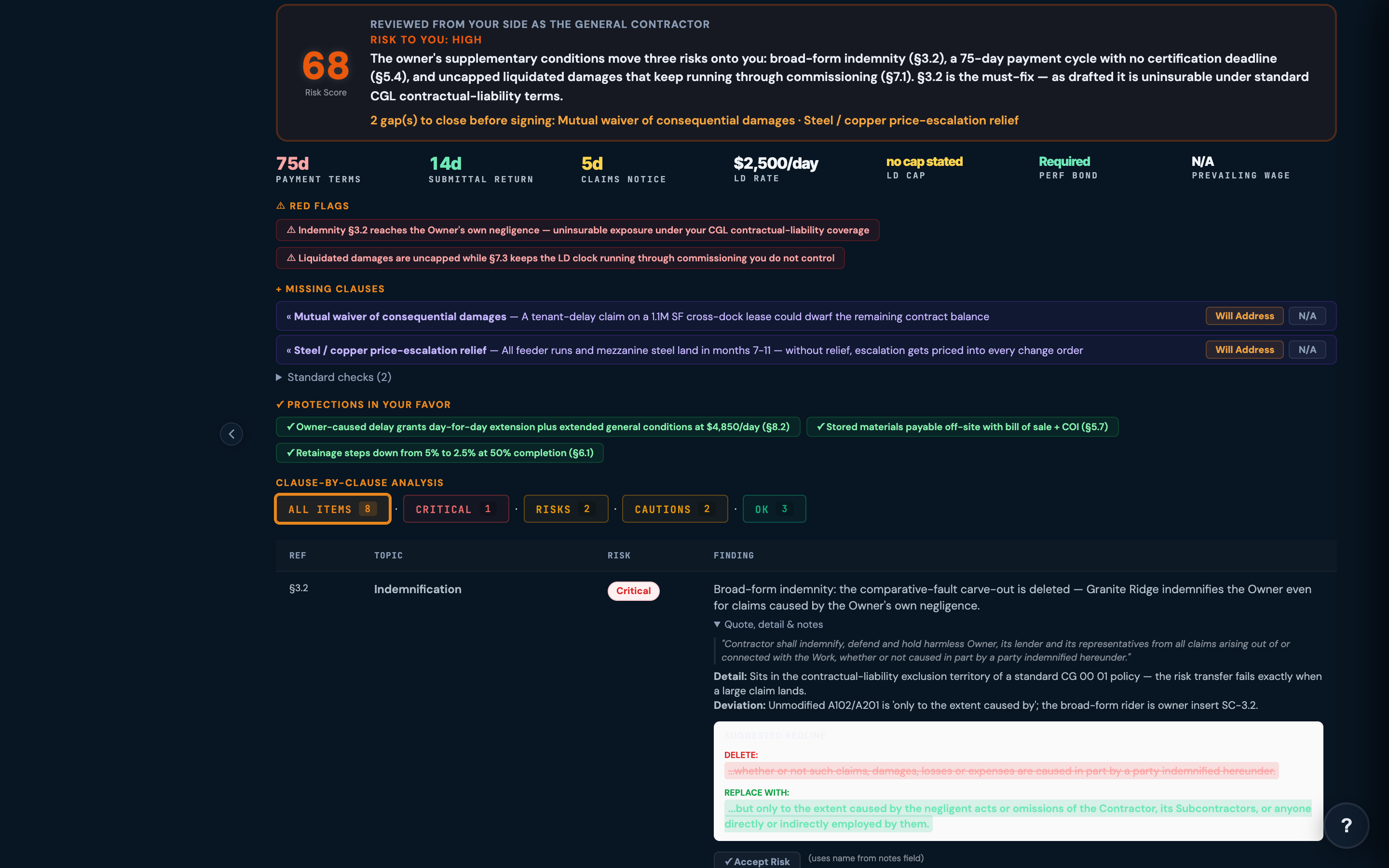
The contract obligates the sub to defend you even when you're the only party at fault. Most state anti-indemnity statutes void this, but the courtroom fight still costs you months. Flagged with the statute that voids it in your jurisdiction.
Standard AIA A201 §15.1.7 waives consequential damages mutually. Custom owner contracts strip this and the sub contract inherits the gap. We surface it and inject the canonical AIA waiver as a counter.
Your firm's standard is net 30 from pay-app approval. The contract says "net 90 from owner payment to GC" — effectively net 120+ on most jobs. The vendor's cash-flow math will catch this before yours does.
The contract demands an unconditional waiver in exchange for a check that hasn't cleared. Industry standard is conditional waivers before, unconditional after funds clear. We flag the swap and point to the §11 lien waiver language we'd accept.
Your firm requires sub LOL caps at no less than 100% of subcontract value. The contract caps liability at insurance proceeds (often $1M general aggregate — shared across all your subs' claims on the year). Flagged with your standard cap stipulation.
The contract pulls forward a generic $2M/$4M GL package onto a small painting sub doing $80K of work. Sub will likely push back at signing. We flag the over-spec and propose a tier appropriate to the contract value.
Upload the subcontract. We render it next to your firm's preferred terms profile and surface every divergence. Severity-tagged, line-cited, with counter-language ready to paste into your redline tool.
A risk register + a redline-ready Word document with track changes pre-applied. Hand it to your sub. Or hand it to your counsel for final review — with the findings already triaged.
The engine doesn't review against a generic "industry-standard" rulebook. It reviews against your firm's preferred terms — the patterns that show up in every contract you've actually signed.
We extract the clause patterns: how you indemnify, how you pay, what you cap, what you waive. Ten minutes. No template-building.
When your legal counsel updates a standard mid-year, the engine notices the new pattern after 2–3 executed contracts and asks if you want to make it canonical.
What you accept on a $40K paint package isn't what you accept on a $4M steel package. The library carries trade-specific overrides — LOL caps that scale with contract value, insurance tiers, lien-waiver windows.
Most contract-review tools were trained on commercial leases and SaaS MSAs. Ours was trained on the documents construction actually signs — AIA, ConsensusDocs, EJCDC, and the bespoke owner contracts that mash them together.
Owner–contractor agreements. Stipulated sum, cost-plus, fixed-price-with-GMP. We map all three back to a common clause skeleton.
The 50-page master that most owner contracts cross-reference. Parsed clause-by-clause, change tracking against the 2017 and 2007 editions.
The sub-side documents. Standard form vs the modified version your owner pushed downstream — we surface every modification.
Industry alternative to AIA. Same coverage: owner agreement, GC–sub, design-build variants.
Civil and infrastructure-leaning. Engineer-administered work. Common on DOT, water-treatment, and public-bid jobs.
Owner-drafted Word docs that don't follow any standard. We map them back to comparable AIA / ConsensusDocs clauses and flag what's missing.
Time: 4–10 business days · Cost: $1,500–$5,000 per contract
Highest quality, deepest analysis. But you can't run every $80K subcontract through outside counsel — the math doesn't work. So most firms cap legal review at contracts above some threshold ($500K? $1M?) and sign the rest blind.
Time: minutes · Cost: $0.10–$5 per scan
Fast, but trained on commercial leases. Catches grammar issues and undefined terms. Misses construction-specific patterns: lien-waiver timing, retainage drift, AIA cross-references, anti-indemnity statute conflicts.
Time: ~30 seconds · Cost: 1 engine run from your plan
Construction-trained. Reviews against your firm's terms, not generic standards. Counsel still owns the high-risk contracts. The other 80% get a competent first pass before signing.
To be clear. This doesn't replace counsel. For master agreements, large GMP contracts, and anything novel, you still want a lawyer. What this replaces is the unreviewed-because-too-small contract that signs on autopilot — and then bleeds margin for 18 months.
Owner counsel knows you scan, not read. These patterns slip past most review — including most attorneys reviewing 80 pages on a deadline.
Pay-when-paid is a timing mechanism — the GC eventually pays. Pay-if-paid is a condition precedent — the sub bears the risk of owner non-payment entirely. Many state courts now require explicit "condition precedent" language to enforce the latter; we flag the swap and surface the controlling case law for your jurisdiction.
Standard AIA treats time as recoverable through schedule adjustments. Owner counsel inserts "time is of the essence" alongside fixed milestones — any delay becomes a material breach. Flagged with the AIA §8.3 language we'd substitute.
LDs without an aggregate cap mean a 90-day delay = $450K exposure. Industry-standard cap is 5–10% of contract value. We surface the LD provision, calculate worst-case exposure against the schedule, and propose a cap that fits your firm's tolerance.
Without a defined standard (e.g., "industry-accepted practices for the trade"), "workmanlike" becomes whatever the owner argues it should be. Punch-list disputes turn into warranty claims. We propose ANSI / ICC reference language as the floor.
Open-ended scope language that pulls in any work the owner argues should have been inferred. Different from the AIA standard ("indicated by or reasonably inferable from"). Flagged with the AIA §3.1.1 phrasing that bounds inferable work to what's indicated.
Common in public-bid work but increasingly creeping into private contracts. Owner-caused delay extends the schedule but bars your delay-cost claim. Most states carve exceptions (active interference, fraud, etc.) — we flag the clause with the state-specific carveouts that survive it.
Contract Review reads cleanly on its own, but its output feeds the rest of the project memory.
No. It replaces the unreviewed contract — the small sub that signs on autopilot because routing it through counsel would cost more than the contract is worth. For master agreements, large GMP contracts, or anything materially novel, counsel still owns the review. We make sure they're not the bottleneck on contracts where the math doesn't justify a full review.
Typically 20–45 seconds for a standard subcontract. Custom owner agreements with 80+ pages of exhibits land closer to 60–90 seconds. You get back a risk register, a severity-tagged findings list, and an optional redline-ready Word document with track changes pre-applied.
AIA (A101, A102, A104, A201, A401, A441), ConsensusDocs (200 and 750 series), EJCDC (C-700, C-800), plus arbitrary bespoke contracts in PDF or Word. For non-standard forms, we map clauses back to the closest AIA equivalent and flag what's missing.
Two options. Onboarding: upload your last 5 executed contracts and we extract patterns automatically. Manual: walk through a 12-clause questionnaire (indemnity, LOL caps, payment terms, lien waivers, etc.) and set your standards explicitly. Most firms do both — the upload populates defaults, the questionnaire overrides where it matters.
Documents are processed against your project's private storage, encrypted at rest, never used to train shared models. Your firm's preferred-terms library stays in your tenancy. Optional: turn on aggregate-anonymized benchmarking and your data contributes to market-rate comparisons (LOL caps, retainage tiers, payment terms) — nothing is ever tied back to your firm or a specific contract. Off by default.
Yes — both the clean executed version and an in-flight version with track changes. We surface what changed, who proposed it (when the metadata is intact), and whether each change moves toward or away from your firm's preferred terms. Useful when you're three rounds deep into negotiation and trying to remember what you already agreed to.
Yes. Reviewing the owner agreement is the same flow with the perspective flipped — we compare against your firm's GC-side preferred terms (cap structures, retainage acceptance, schedule float ownership, etc.). Most firms run both: owner contracts review-only, sub contracts review + redline.
Bring a real subcontract to a 15-minute call. We'll review it on screen against your firm's preferred terms. You keep the output.
Start free — 14 days, no card →