Mobile capture in the field: photos, voice tags, crew counts. End-of-day synthesis at the desk: a structured daily log that auto-counts manpower by trade, attaches the day's weather, maps work to schedule activities, and flags gaps before they become problems. The PM stops chasing supers for their logs.
The super's existing day — walking the floors, eyeballing crews, watching deliveries arrive — produces the data. The engine just collects it, structures it, and routes it.
The super opens the app, takes 8–15 photos through the day, dictates a 5-second voice note per photo. "L4 east, MEP rough-in, Acme has 6 guys." The voice gets transcribed; the photo is geotagged + timestamped.
At 5pm the engine pulls the day's captures, weather from NOAA for the project ZIP, deliveries logged in Procurement, the schedule activities scheduled for the day, and any meeting that touched the project. Synthesizes them into one log entry.
Daily log entry goes to project memory. Deliveries received hit the Procurement tracker. Crew counts feed Schedule Risk's manpower forecasting. Safety incidents route to the safety log. Owner sees the redacted version in their next report.
One synthesized entry, every day, with the data the project actually needs — not just the data the super remembers to type.
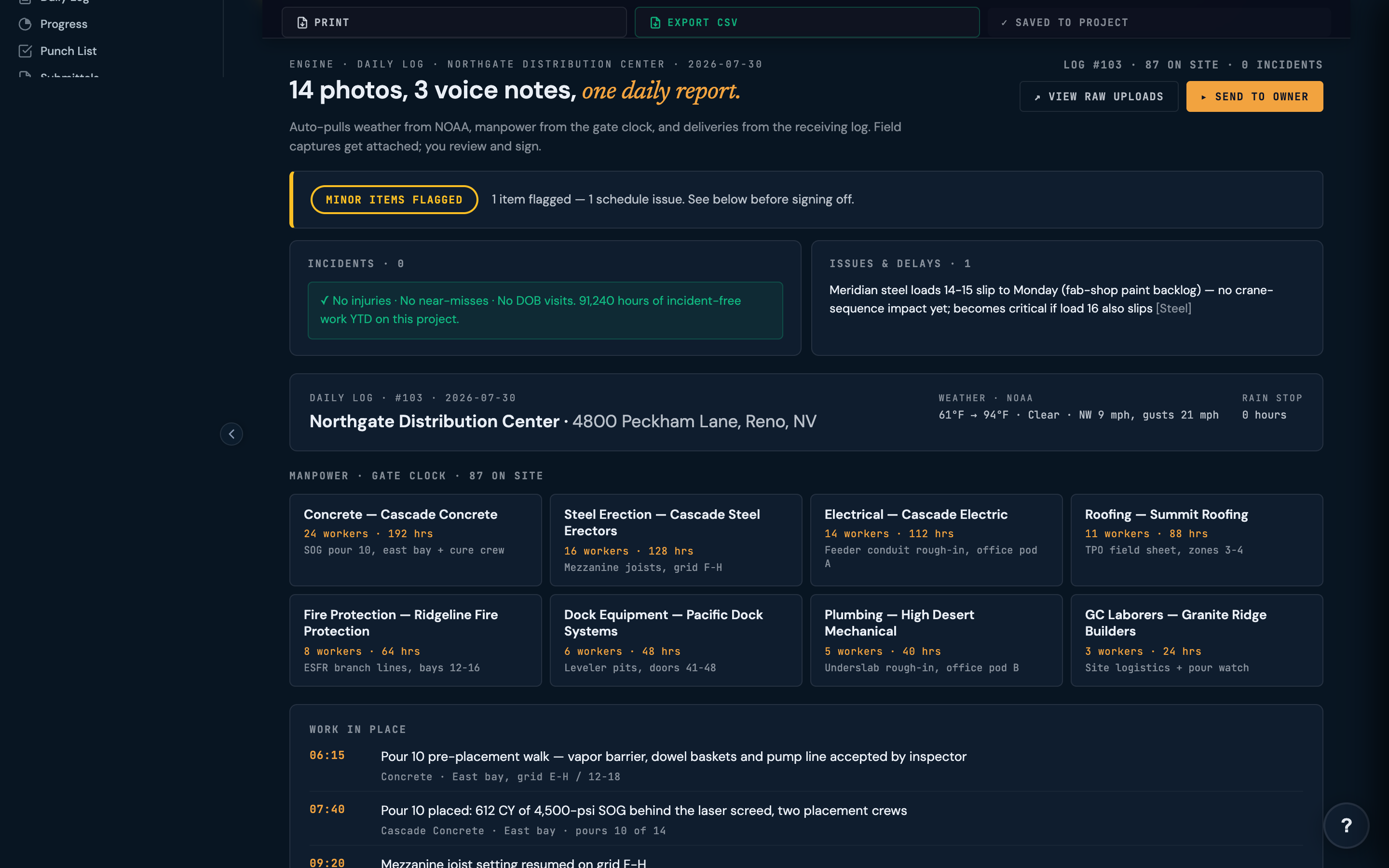
Most daily logs only record what happened. We also surface what was supposed to happen and didn't appear in the captures. That gap — the activity scheduled for today with no evidence of work — is where schedule slip starts. We flag it on day 1, not on day 30 when the four-week look-ahead reveals it.
The super already does the field work. The PM already needs the log. We're just stitching them together so neither has to do the data-entry that nobody enjoys.
Supers don't write good daily logs because their job is to walk the site, not type at the laptop. The best supers send back a few photos and a paragraph of texts — you piece it together at the desk. Many never send anything, and you spend Monday morning reconstructing Friday from memory.
This engine doesn't try to change how the super works. They keep walking. They keep snapping photos. They keep dictating two-sentence voice notes when something matters. The engine reads the photos, transcribes the voice, counts the crews, adds the weather, maps to the schedule, and produces the log entry the PM and owner expect.
For the PM: a clean entry on their desk by 5:30pm every day. For the owner: a one-page weekly that includes manpower curves, schedule progress, and any gap flags — without the PM having to assemble it.
This is the unfair advantage. We use computer vision on the field photos to count people by trade — not perfectly, but consistently. Over 60 days that's 60 manpower-by-trade data points the PM can review without anyone hand-typing them.
The schedule assumes "MEP rough-in needs 12 workers for 14 days." The photos show MEP averaging 8 workers for the last 6 days. We flag the manning gap before it becomes a schedule slip.
Charts show concrete crew demobilizing (expected), MEP scaling up (expected), drywall starting (expected). Anything missing — a trade that should be ramping but isn't — surfaces as a flag.
Counting accuracy improves over the first 2–3 weeks per project as the engine learns your site conditions and PPE color patterns. Manual override on any count is one tap.
The daily log isn't useful as a standalone artifact — it's useful when other engines read it and act.
Capture works through the existing site-walk routine — opening the camera, taking a photo, holding the mic button while talking. No data entry, no forms. If the super is already sending you photos and texts, capture is the same gesture in one app instead of three. If they're truly app-resistant, the PM can capture during walk-throughs and the engine still produces the synthesized log.
Captures save locally and sync when connectivity returns. Voice transcription runs on-device for the first pass; cloud refinement happens at sync time. We've tested in basement-level work, parking structures, and rural sites — offline capture is the default expectation, not the edge case.
In pilots: 85–92% accuracy on first-day deployment, improving to 94%+ after the engine has learned your site's PPE patterns (helmet colors, vest brands, trade identifiers). Manual override is one tap. We treat the counts as triangulation, not ground truth — they're checked against trade-submitted manpower roll-ups when those exist.
Limited beta opening June 2026 for pilot teams. Priority access for firms already using one of our LIVE engines (Bid Leveling, Contract Review, CO Review). Sign up to get the invite.
If your super is already snapping site photos and you're already piecing them into a log on Monday morning — you're the user we built this for. We're opening 20 pilot seats in June.
Reserve a beta seat →