01
Paint zones on the sheet
Tap inside an enclosed area to flood-fill it, or tap corners to trace it. Color-coded zones land on any plan sheet or elevation — the drawings you already have, no capture hardware.
Color-coded zones on any sheet or elevation — flood-fill tap or corner-tap — become a quantity-weighted percent complete. Per-trade rules of credit, installed counts, and a one-click pull into the schedule and the G703 pay app. No capture rigs, no Excel round-trip.
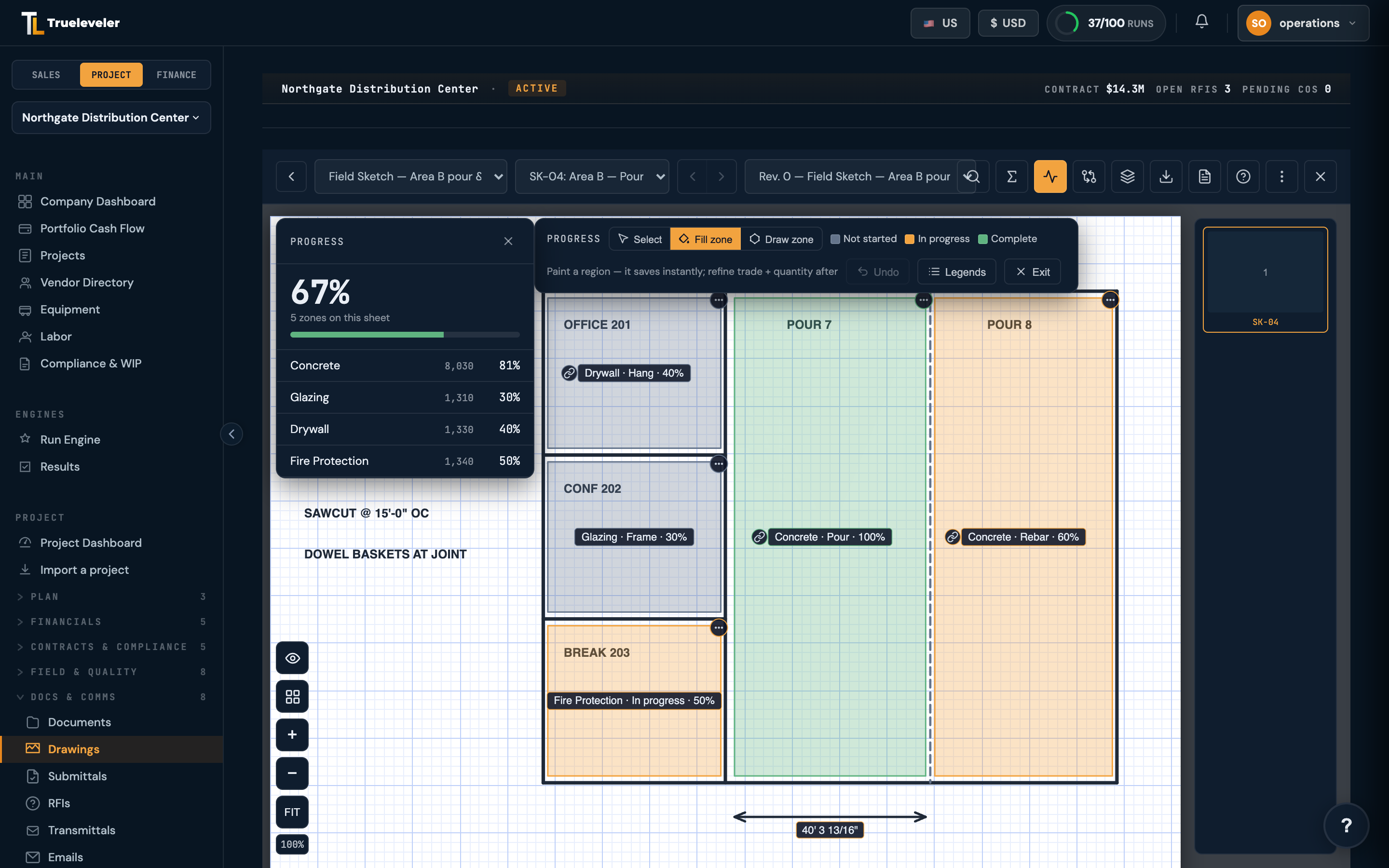
Tap inside an enclosed area to flood-fill it, or tap corners to trace it. Color-coded zones land on any plan sheet or elevation — the drawings you already have, no capture hardware.
Each trade gets a stage legend you can customize — framed, hung, finished, each worth its share. Count-based work tracks as installed counts: 500 cleats, 320 in, 64%. Percentages are quantity-weighted, not eyeballed.
Zones link to schedule activities and schedule-of-values lines, auto-linked by trade. One click pushes the painted percentages into Schedule and drafts the matching G703 pay-app lines.
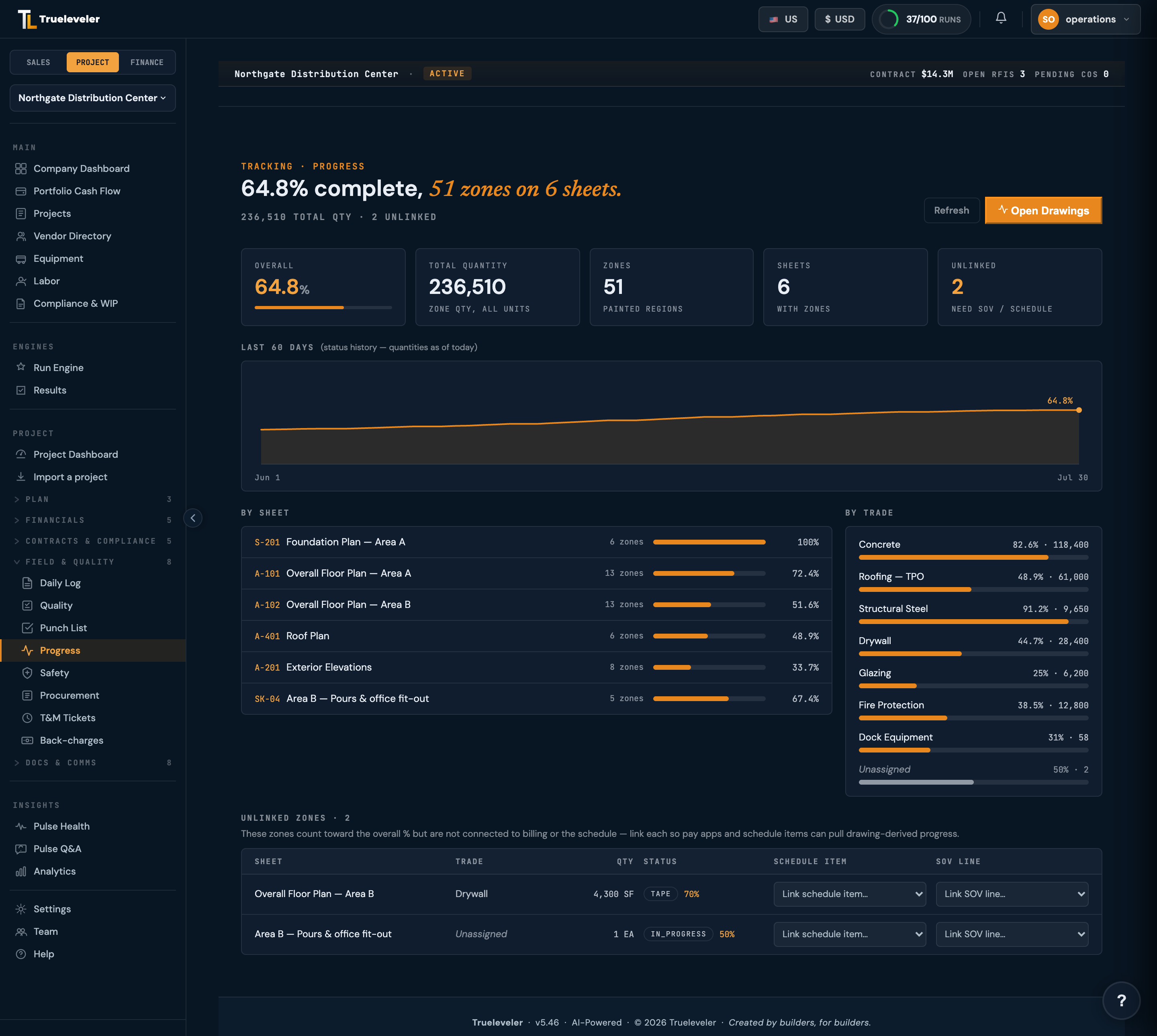
Every painted zone and installed count rolls up to one quantity-weighted project number — the figure your owner, your lender, and your pay app all ask for.
Slice the rollup by sheet or by trade. See that Level 2 drywall is at 78% while Level 3 sits at 41% — and which sub owns the gap.
Progress over the last 60 days, plotted. A flat line on a trade you're paying monthly is a conversation worth having before the next pay app.
Zones not yet tied to a schedule activity or SOV line surface in one triage list, so nothing you painted is stranded outside the schedule and the billing.
Not every sheet needs zones on day one. Drag a rough-estimate slider to a gut-feel percent and the sheet joins the rollup immediately — refine it with paint later.
Auto-link matches zones to activities and SOV lines by trade; batch assign sweeps up the rest in one pass instead of one dropdown at a time.
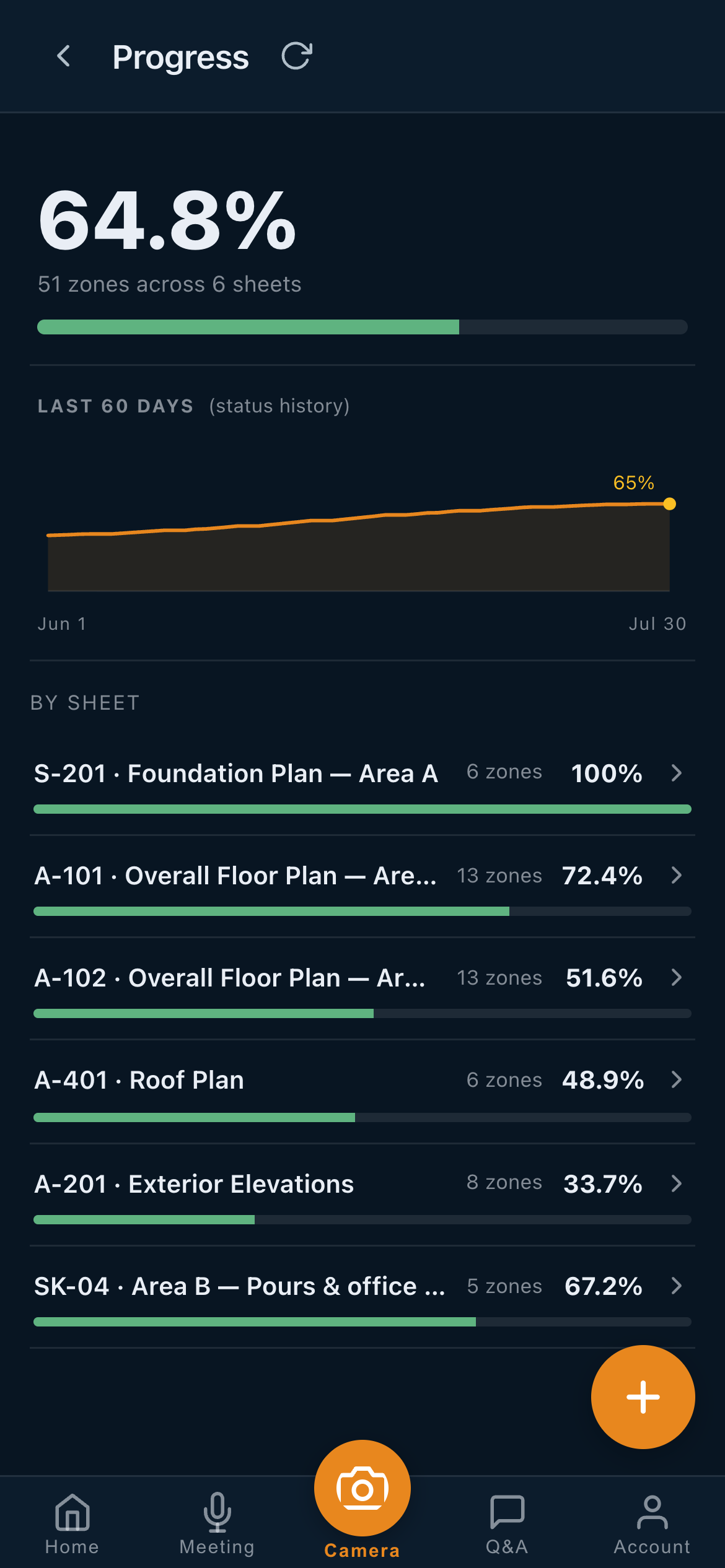
One tap from launch: the Progress tile on the app's home screen opens the painter. Walk the floor, tap the zone, done — before the superintendent is back at the trailer. Get it on the App Store.
Flood-fill painting, corner-tap zones, stage legends, and installed counts all work on the phone exactly as they do on the desktop — the field isn't limited to read-only.
Sheets are available offline in the app, so a dead corner of the building doesn't end the walk. Updates sync when the signal comes back.
Reality-capture platforms want a 360 camera on a hardhat and an AI-capture subscription before you see a number. Trueleveler's input is the walk you already do and the drawings you already have. If you need photogrammetry-grade scans, those tools are genuinely better at that — this is progress tracking, not reality capture.
Most progress tools end at an export. Here the percent complete lives in the same platform as the schedule and the pay app, so "pull into G703" is a click — not a Friday-afternoon copy-paste between three files.
Facade, glazing, masonry, and roofing progress doesn't happen on a floor plan. Zones paint onto elevation sheets the same way they paint onto plans, so vertical trades get real quantity-weighted percentages too.
The percentages come from your team's eyes on the work — the quantity weighting, stage legends, and installed counts keep that judgment honest. No AI is guessing your percent complete from a blurry photo.
Blank sheets at real drawing scale, imperial and metric. A line you draw is a real dimension, not a doodle — and a scale bar rides every export.
Snap to a square grid for plans and details, or flip to an isometric grid for risers and spool-style sketches. Live dimensions in real units as you draw.
Because the sheet is truly to scale, takeoff measurements read straight off your field sketch — lengths and areas you can price, not estimates of an estimate.
12 industry material hatches, 6 drafting line types plus spline, QuickShape, stamps, and dimension labels — the same markup kit used on your drawing sheets.
Overlay or split-view two revisions of a sheet with change clouds — and the drawings, sketches included, are available offline in the field app.
Author a scaled sketch from the app's home screen — an as-found condition, a rework detail, a T&M exhibit — without waiting to get back to a desk.
Every engine output is the next engine’s input. Try the platform free — no card, no implementation call.